


Greenland, Venezuela, and the Geopolitical Impact on Portfolios
You've likely seen recent news coverage around Greenland, Venezuela, NATO, and more. These developments have captured headlines and raise questions around geopolitical stability and the global economy. It's natural to wonder what this might mean for your portfolio and financial plan.
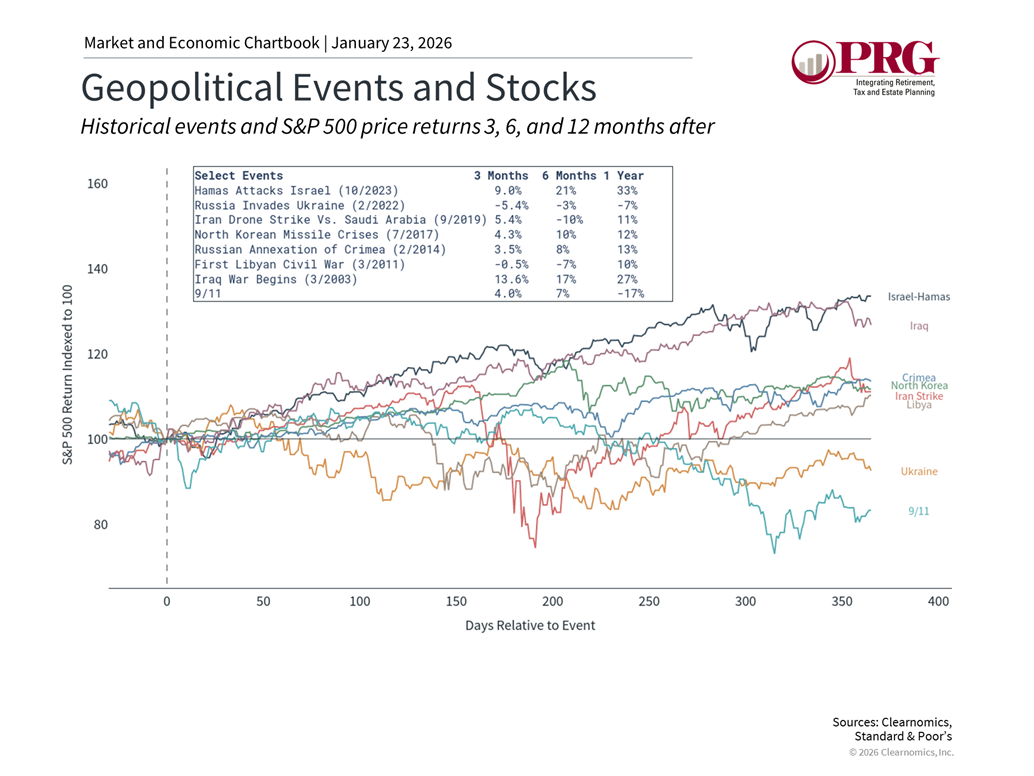
The short answer is that history shows us that geopolitical events rarely have lasting impacts on the market, even when they may feel significant in the moment or receive significant news coverage.
What Happened and Why It Matters
Several geopolitical developments have appeared in recent headlines. Tensions have escalated over Greenland, which is a territory of Denmark, with the administration pursuing negotiations for control of the island and possibly imposing tariffs on several European countries. These actions have strained relationships with NATO allies and prompted strong reactions from European leaders. Separately, the U.S. military conducted an operation that detained Nicolás Maduro in Venezuela on charges related to drug trafficking and corruption.
From an investor viewpoint, the most important lesson from history is that geopolitical shocks tend to create short-term volatility, but don't typically change the direction of markets over the long run. We've seen this pattern repeatedly in recent years with conflicts in Ukraine and the Middle East. This is because geopolitical events can temporarily affect sentiment and commodity prices. However, they rarely alter the underlying market and economic drivers in a lasting way.
The Commodity Connection
President Trump has stated that the U.S. will work to expand Venezuela's oil production. For context, Venezuela possesses the world's largest proven oil reserves, even more than Saudi Arabia. Similarly, Greenland is in the news because it is resource-rich, including rare-earth metals, minerals, and offshore oil, and is strategically placed on the map for U.S. national defense.
The typical way geopolitical events affect portfolios is through commodity prices, particularly oil. This situation is different from Russia's invasion of Ukraine in 2022, which disrupted existing supply and pushed oil prices to nearly $128 per barrel. That crisis worsened inflation and sent gasoline prices above $5 per gallon.
In contrast, increased production from places like Venezuela would likely place downward pressure on oil prices over time, which could actually be positive for consumers and the broader economy. Current oil prices remain subdued, trading around $60 per barrel, well below historic peaks. Major U.S. oil companies may also benefit as they access these reserves, but this will also take time to play out.
Market Reactions
Recent market volatility has reflected investor concerns about shifting global economic dynamics, causing swings in stocks, bonds, and the dollar. This represents a departure from historical patterns where investors typically flocked to U.S. assets during periods of uncertainty.
Some suggest that escalating tensions could prompt countries to invest elsewhere, make new trade alliances, and rethink economic relationships. While these concerns deserve attention, it's worth noting that similar worries have emerged periodically, and U.S. markets have proven resilient over time.
It's also important to acknowledge current market valuations. By many measures, U.S. stocks appear expensive relative to historical averages. This doesn't predict near-term direction, but it does suggest that maintaining a diversified, long-term approach is prudent.
Your Portfolio Is Built for Uncertainty
When geopolitical tensions rise, it's important to remember that your portfolio is constructed with diversification across asset classes, sectors, and geographies. This approach is specifically designed to weather periods of uncertainty without requiring reactions to every news event.
Most investors have minimal or zero direct exposure to the specific regions dominating current headlines. For instance, Greenland and Venezuela play essentially no role in global financial markets. Additionally, Venezuela has been in default on its bonds since 2017, so there's minimal exposure through fixed income markets.
These geopolitical situations will continue to evolve, and there may be additional developments that capture headlines. Rather than trying to predict exactly how things will unfold, investors should focus on what can be controlled.
Disclosure: This content is developed from sources believed to be providing accurate information. The information provided is not written or intended as tax or legal advice and may not be relied on for purposes of avoiding any Federal tax penalties. Individuals are encouraged to seek advice from their own tax or legal counsel. Individuals involved in the estate planning process should work with an estate planning team, including their own personal legal or tax counsel. Neither the information presented nor any opinion expressed constitutes a representation by us of a specific investment or the purchase or sale of any securities. Asset allocation and diversification do not ensure a profit or protect against loss in declining markets. This material was developed and produced by Advisor Websites to provide information on a topic that may be of interest.
Content in this material is for general information only and not intended to provide specific advice or recommendations for any individual. All performance referenced is historical and is no guarantee of future results. All indices are unmanaged and may not be invested into directly. All investing involves risk including loss of principal. No strategy assures success or protects against loss. There is no guarantee that a diversified portfolio will enhance overall returns or outperform a non-diversified portfolio. Diversification does not protect against market risk.
The economic forecasts set forth in this material may not develop as predicted and there can be no guarantee that strategies promoted will be successful.
Copyright (c) 2026 Clearnomics, Inc. All rights reserved. The information contained herein has been obtained from sources believed to be reliable, but is not necessarily complete and its accuracy cannot be guaranteed. No representation or warranty, express or implied, is made as to the fairness, accuracy, completeness, or correctness of the information and opinions contained herein. The views and the other information provided are subject to change without notice. All reports posted on or via www.clearnomics.com or any affiliated websites, applications, or services are issued without regard to the specific investment objectives, financial situation, or particular needs of any specific recipient and are not to be construed as a solicitation or an offer to buy or sell any securities or related financial instruments. Past performance is not necessarily a guide to future results. Company fundamentals and earnings may be mentioned occasionally, but should not be construed as a recommendation to buy, sell, or hold the company's stock. Predictions, forecasts, and estimates for any and all markets should not be construed as recommendations to buy, sell, or hold any security--including mutual funds, futures contracts, and exchange traded funds, or any similar instruments. The text, images, and other materials contained or displayed in this report are proprietary to Clearnomics, Inc. and constitute valuable intellectual property. All unauthorized reproduction or other use of material from Clearnomics, Inc. shall be deemed willful infringement(s) of this copyright and other proprietary and intellectual property rights, including but not limited to, rights of privacy. Clearnomics, Inc. expressly reserves all rights in connection with its intellectual property, including without limitation the right to block the transfer of its products and services and/or to track usage thereof, through electronic tracking technology, and all other lawful means, now known or hereafter devised. Clearnomics, Inc. reserves the right, without further notice, to pursue to the fullest extent allowed by the law any and all criminal and civil remedies for the violation of its rights.