


Portfolio Lessons During Strong Market Conditions
Financial markets have had a positive, yet eventful year so far, so I wanted to take a moment to share some perspective on what it means for your long-term financial plan.
Many asset classes have performed well, despite a turbulent start to 2026. The broader lesson is that investors who maintain portfolio balance through these periods are better positioned to weather short-term challenges and participate in the recoveries that follow. Market swings are a natural part of investing, and their effects on markets and the economy tend to fade over time.
This will only become more relevant as market uncertainty continues.
Many asset classes have supported portfolios this year
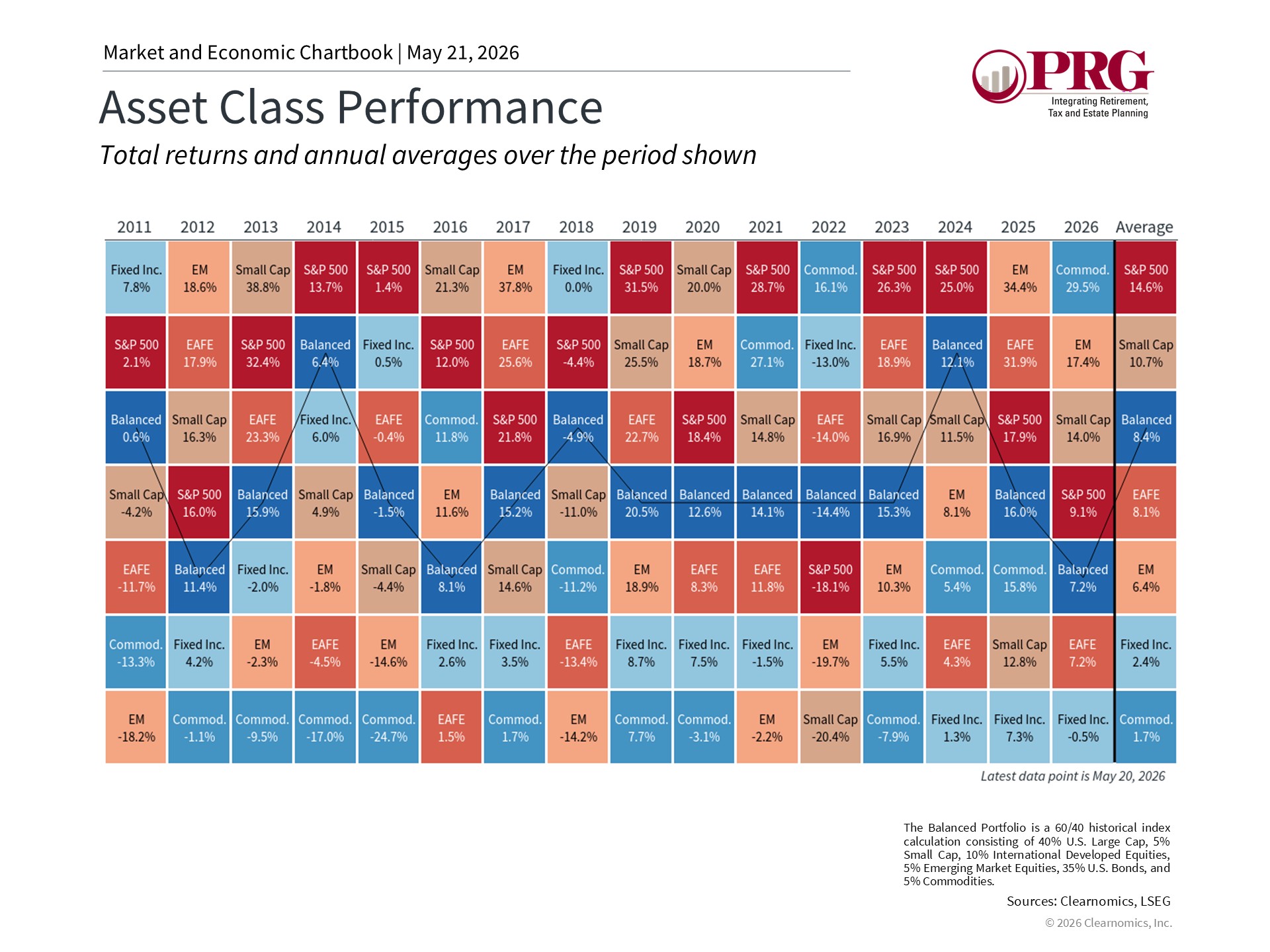
The most important story of 2026 is how different parts of the market have contributed to portfolio performance. While U.S. stocks stumbled early in the year, the S&P 500 has rebounded to many new all-time highs. Several other asset classes have performed even better during this period.
This is one of the reasons we build portfolios holistically with your long-term financial goals in mind. For instance, the top-performing asset class year-to-date is commodities, returning more than 30%, driven largely by rising energy prices. Emerging market stocks have returned over 20%, benefiting from a weaker U.S. dollar and improving conditions in several regions. Small cap stocks have also outperformed as the economy has continued to grow and interest rates have moderated. The point is not that these specific asset classes or sectors will continue to outperform, but rather that holding a mix of appropriate investments can support portfolios over the long run.
While bonds have been flat this year, they have continued to play an important role in stabilizing portfolios. At the same time, bond yields remain well above their long-term averages across most fixed income categories. The U.S. Aggregate Bond Index currently yields around 4.7%, compared to a historical average of approximately 3.0% since 2009. For portfolio income, these yields remain attractive.
Within the stock market, the importance of broad diversification has also been clear. Sector returns have varied widely in 2026, with energy leading the market. At the same time, nine of the 11 sectors are positive this year, including technology, materials, communication services, and industrials. An investor relying on just one or two sectors would have experienced considerably more volatility this year than one who held a broader portfolio.
In any given year, leadership can rotate across sectors, regions, and styles in ways that are difficult to predict in advance, but that can support investors nonetheless. While there are never any guarantees when it comes to investing, this is consistent with what history shows across many market cycles.
Macroeconomic forces continue to shape markets
For much of the history of the stock market, investing was primarily about individual stocks and bonds. Over the past few decades, however, macroeconomic developments have increasingly affected markets, at least in the short run. For investors, this means that building modern portfolios is less about finding the most attractive basket of stocks, and more about making asset allocation decisions that are aligned with financial goals.
The two biggest macroeconomic drivers over the past year and a half have been the war in Iran and evolving U.S. tariff policy. While these are quite different in nature, they both affect consumer prices and business demand, either directly through higher energy prices or indirectly through the cost of imported goods.
The possibility of higher inflation means there are risks we will need to navigate. The Consumer Price Index shows that prices have risen 3.8% over the past year, driven in large part by higher gasoline prices tied to the closure of the Strait of Hormuz.
This is why a key principle of investing is to hold a portfolio that can generate both growth and income, tailored to your financial goals. Doing so can build wealth and outpace inflation over time. The fact that many asset classes are supporting portfolios so far this year is positive and can help position you for whatever lies ahead.
Disclosure: This content is developed from sources believed to be providing accurate information. The information provided is not written or intended as tax or legal advice and may not be relied on for purposes of avoiding any Federal tax penalties. Individuals are encouraged to seek advice from their own tax or legal counsel. Individuals involved in the estate planning process should work with an estate planning team, including their own personal legal or tax counsel. Neither the information presented nor any opinion expressed constitutes a representation by us of a specific investment or the purchase or sale of any securities. Asset allocation and diversification do not ensure a profit or protect against loss in declining markets. This material was developed and produced by Advisor Websites to provide information on a topic that may be of interest.
Copyright (c) 2026 Clearnomics, Inc. All rights reserved. The information contained herein has been obtained from sources believed to be reliable, but is not necessarily complete and its accuracy cannot be guaranteed. No representation or warranty, express or implied, is made as to the fairness, accuracy, completeness, or correctness of the information and opinions contained herein. The views and the other information provided are subject to change without notice. All reports posted on or via www.clearnomics.com or any affiliated websites, applications, or services are issued without regard to the specific investment objectives, financial situation, or particular needs of any specific recipient and are not to be construed as a solicitation or an offer to buy or sell any securities or related financial instruments. Past performance is not necessarily a guide to future results. Company fundamentals and earnings may be mentioned occasionally, but should not be construed as a recommendation to buy, sell, or hold the company's stock. Predictions, forecasts, and estimates for any and all markets should not be construed as recommendations to buy, sell, or hold any security--including mutual funds, futures contracts, and exchange traded funds, or any similar instruments. The text, images, and other materials contained or displayed in this report are proprietary to Clearnomics, Inc. and constitute valuable intellectual property. All unauthorized reproduction or other use of material from Clearnomics, Inc. shall be deemed willful infringement(s) of this copyright and other proprietary and intellectual property rights, including but not limited to, rights of privacy. Clearnomics, Inc. expressly reserves all rights in connection with its intellectual property, including without limitation the right to block the transfer of its products and services and/or to track usage thereof, through electronic tracking technology, and all other lawful means, now known or hereafter devised. Clearnomics, Inc. reserves the right, without further notice, to pursue to the fullest extent allowed by the law any and all criminal and civil remedies for the violation of its rights.